Introduction
In today’s fast-growing digital world, parents want to strengthen their children’s mental abilities early. One of the most effective tools for building strong mathematical and cognitive skills is the abacus. Abacus learning has been used for centuries, and modern research shows that it plays a major role in boosting brain development in children.
If you are a parent wondering “Should my child learn abacus?” — this guide will answer everything.
What Is an Abacus?
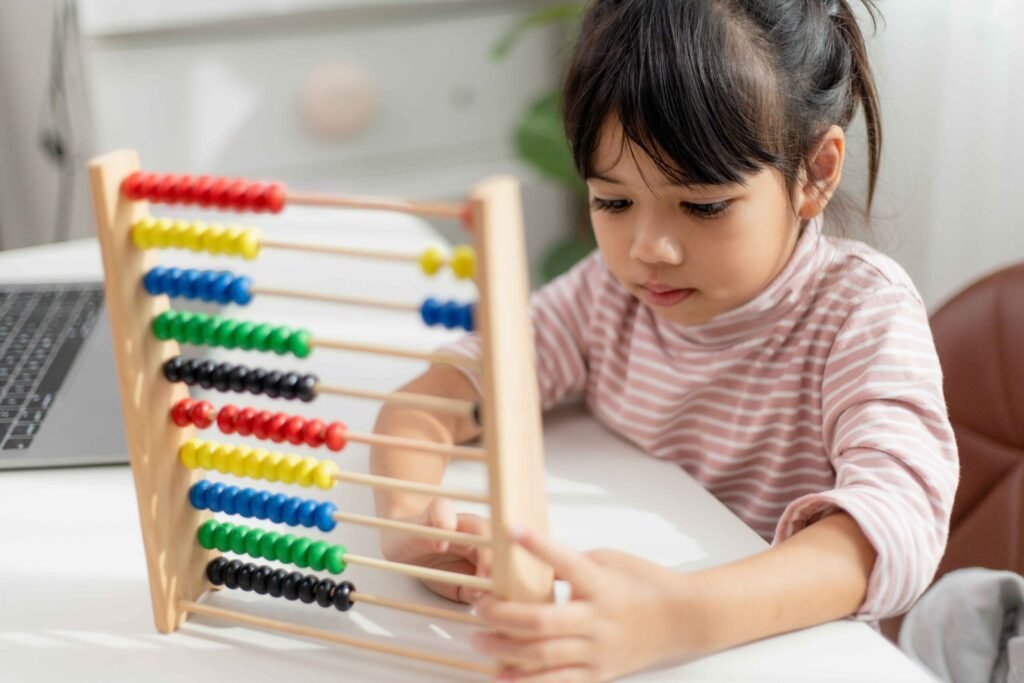
An abacus is a simple, manual calculating device made with beads arranged in rods. Children use finger movements to perform addition, subtraction, multiplication and division.
Over time, this practice trains them to visualize the abacus in their mind — a technique known as mental arithmetic.
Benefits of Abacus Learning for Children
- Strengthens Concentration
- Abacus practice involves focused bead movement and mental visualization. This improves children’s ability to stay attentive for longer periods.
- Enhances Memory Power
- Kids constantly remember bead positions, formulas, and patterns — making their short-term and long-term memory sharper.
- Improves Mathematical Speed & Accuracy
- With practice, children perform calculations 10x faster than traditional methods.
- Boosts Confidence
- Solving big calculations effortlessly at a young age builds strong academic confidence.
- Develops Both Left & Right Brain
- Left brain → Logical & analytical skills
- Right brain → Creativity, visualization, imagination
- Abacus activates both hemispheres, creating balanced brain development.
- Reduces Math Phobia
- Children treat math as a fun game instead of a difficult subject.
Ideal Age for Abacus Learning
The best age to start abacus training is 5 to 14 years, when the brain is most receptive and adaptable.
How Abacus Training Works
- Basic Level – Understanding beads, positions, formulas
- Intermediate Level – Speed calculations, finger techniques
- Advanced / Mental Level – Solving without an abacus using visualization
Kids gradually shift from physical beads to a mental abacus, which is where true brain development happens.